Geopolitics
The Groundwork: Reading the Rubio Report Against the Venezuela Playbook
The State Department's 100-page Cuba report announces no new action. Read against how Washington built its case before capturing Maduro, it is something more telling: the first move of a sequence Cuba's leaders have already watched play out next door.
Camilo Jaime · July 20, 2026 · Miami
On Monday, July 20, 2026, the State Department released a 100-page report titled “Cuba: The Capital of 21st Century Communism.” Read on its own, it announces nothing. No new sanction, no operation, no order. It is a document, not a deployment.
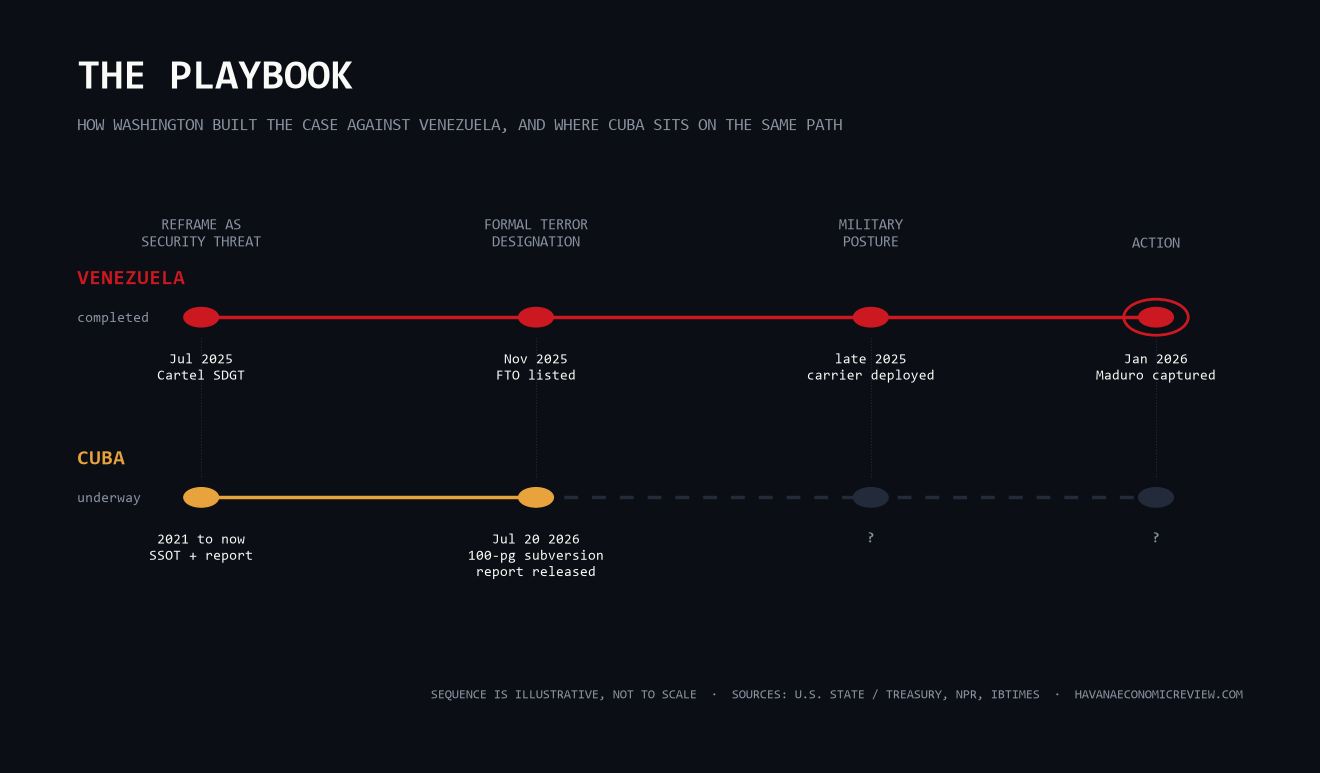
Read against the last twelve months, it is something more specific: the opening move of a sequence Cuba’s leaders have already watched run to completion ninety miles to their south.
The sequence, as it actually ran in Venezuela
Before the United States captured Nicolas Maduro, it spent a year converting a policy preference into a security justification. The dates are a matter of public record:
- July 2025: the Treasury designated Venezuela’s Cartel de los Soles, which it described as headed by Maduro himself, a Specially Designated Global Terrorist.
- November 24, 2025: the State Department escalated that to a Foreign Terrorist Organization designation, formally recasting the Venezuelan state’s leadership as a terror entity rather than a government the U.S. merely opposed.
- Late 2025: a military buildup in the Caribbean, officially an anti-drug mission, positioned warships including the carrier USS Gerald Ford off the Venezuelan coast.
- January 3, 2026: a military operation in Caracas captured Maduro, who now awaits federal trial in Brooklyn on narco-terrorism charges.
The point is not the raid. The point is the order of operations. The legal and political authority to act was not asserted on day one. It was manufactured, in stages, through designation and narrative, until the action looked less like a war of choice and more like the enforcement of a case already made.
Where Monday’s report sits on that same path
Cuba begins further along in one respect: it has carried a State Sponsor of Terrorism designation since 2021. What it had not received, until this week, was the second layer of the Venezuela template, the comprehensive public case that reframes the country from a failed economy the U.S. sanctions into an active security threat the U.S. must confront.
That is what the report is. It accuses the Cuban regime of six decades of espionage, subversion, and infiltration of American institutions. Its strongest material is documented and beyond dispute: real, convicted agents such as Ana Belen Montes, once the Defense Intelligence Agency’s senior Cuba analyst, and Victor Manuel Rocha, a former U.S. ambassador sentenced in 2024 after roughly fifty years as a Cuban asset. These are court records, not allegations.
The report does not stop at documented espionage, and this is where a reader has to hold two categories apart. Alongside the convictions, it asserts that Havana cultivated and steered a range of American domestic movements, and it frames the whole history, in its own words, as “a revolution against Western civilisation itself.” Those are the State Department’s characterizations, not established facts, and they should be read as what they are: the narrative layer of a pressure campaign, doing the same work the narco-terror framing did for Venezuela. A serious reader can accept the espionage convictions as proven and treat the civilizational framing as advocacy, at the same time.
There is also a genuinely strategic claim buried in the document, and it is the one worth watching: that China and Russia have expanded intelligence operations on the island, including signals-intelligence installations. If accurate, it reframes Cuba from a humanitarian problem into a great-power foothold off the Florida coast, which is precisely the kind of argument that justifies action rather than mere sanction.
The discipline this moment requires
It would be easy, and wrong, to read a 100-page report and a captured neighbor as proof that Cuba is next in any literal, imminent sense. The same Secretary of State who has said, of Cuba, “and Cuba’s next, by the way,” has also said plainly that wanting the regime to change “doesn’t mean that we’re going to make a change.” Washington has built cases like this against governments it never touched. Groundwork is a necessary condition for action. It is not a sufficient one, and it is not a schedule.
So the honest formulation is narrow and holds both halves at once: the United States is now assembling, unusually quickly, the justification architecture that any move against Cuba would require, and it is doing so along a template it completed against Cuba’s closest ally within the year. Whether that architecture is ever used is unknown. That it is being built is not.
Why the mechanism is not the question
For anyone weighing Cuba’s future rather than betting on a headline, the most useful observation is that the destination is more legible than the route. Regime change by external pressure, internal collapse under a tightening blockade, or a negotiated exit are very different events with very different timelines. They converge on the same morning after: a Cuba no longer governed as it is today, with a diaspora, a hemisphere, and a body of capital positioned to respond.
The groundwork now being laid does not tell you which road Cuba takes. It tells you the direction of travel has been set at the highest level of the U.S. government, and that the insulation Havana relied on for sixty years, most concretely its alliance with Caracas, is measurably thinner this year than last. That is the fact under the noise.
What we are watching
- Whether the report is followed by new designations or measures that convert its narrative into legal instruments, the Venezuela tell.
- Any hardening of the China and Russia intelligence claims into specific, sourced findings, which would shift the argument from ideology to national security.
- Cuban regime response: concession, defiance, or the quiet repositioning of the ELN negotiators and other exposed assets covered in our earlier analysis.
- Movement in the diaspora-investment and reform signals, the first indicators that any actor believes a transition is being priced rather than merely feared.
Sanctions are studied endlessly because they are loud. The construction of a case is quieter, and it is usually the better predictor. This week, the case against Havana grew by a hundred pages.
Disclosure: Cuba Strategic Partners, this publication’s parent, holds Cuba-related digital assets. Coverage may touch sectors in which CSP holds such assets; that interest is disclosed permanently on our about and methodology pages. Nothing here is investment advice.
Sources & verification
- 01 U.S. State Department: 'Cuba: The Capital of 21st Century Communism' (report, July 20, 2026)
- 02 Secretary Rubio (X): statement introducing the report
- 03 IBTimes UK: State Department accuses Cuba of a 'revolution against Western civilisation itself'
- 04 Cuba Headlines: US exposes decades of Cuban espionage and subversion (Rocha, Montes cases)
- 05 Cuba Headlines: report's claims on Chinese and Russian intelligence sites in Cuba
- 06 U.S. Treasury: sanctions on Venezuela's Cartel de los Soles (SDGT, July 2025)
- 07 U.S. State Department: Terrorist Designation of Cartel de los Soles as an FTO (Nov 24, 2025)
- 08 U.S. State Department: Nicolas Maduro Moros (Captured)
- 09 Wikipedia: 2026 United States intervention in Venezuela (Jan 3 operation; Cuba's stated casualties)
- 10 Washington Monthly: Rubio's bet on regime change in Havana ('Cuba's next')
- 11 The Hill: Rubio warns Cuba after the capture of Maduro
Every figure sourced or labeled an estimate · Methodology
Camilo Jaime
Founder & editor, Havana Economic Review. Miami-born, Cuban-American operator. Full bio →