Policy Briefing
Cuba Now Has Two Sanctions Rulebooks. A Free Transition Would Need a Public Ledger
OFAC's new Part 516 and revised Part 515 harden two distinct Cuba sanctions systems. Their structure shows which records a democratic transition would need.
AI-assisted scenario analysis · present facts are sourced · future conditions are not forecasts
Havana Economic Review Research Desk · October 6, 2026 · Miami
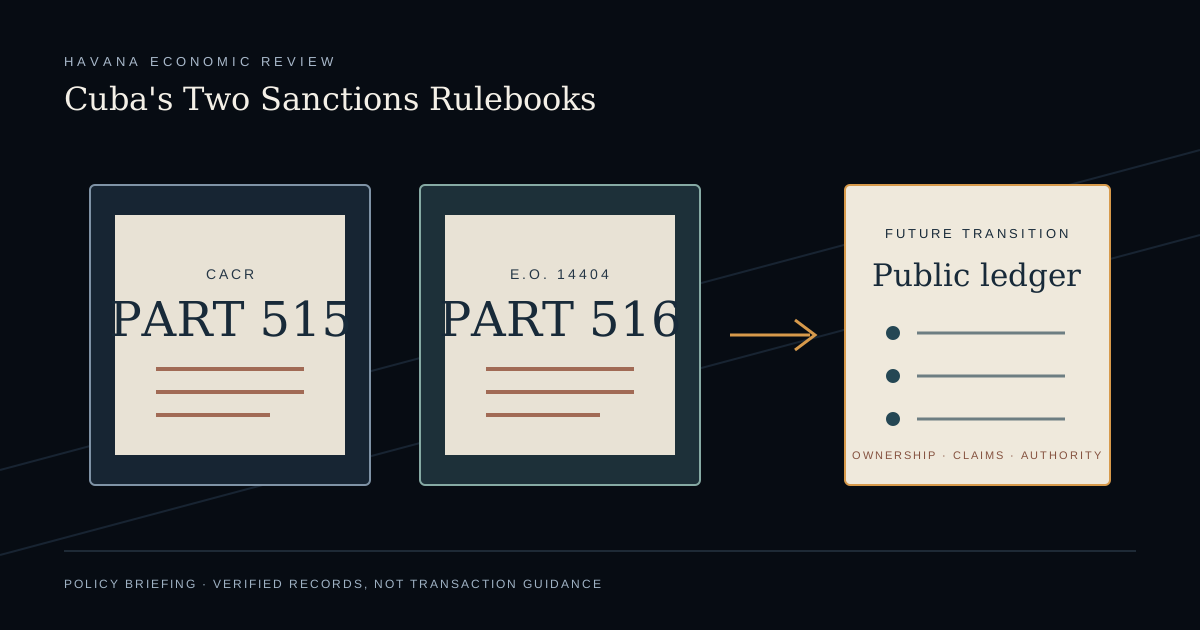
The United States now administers two separate Cuba sanctions rulebooks.
On September 30, the Treasury Department’s Office of Foreign Assets Control put a new 31 CFR Part 516 into effect to implement Executive Order 14404. On the same day, it tightened the older Cuban Assets Control Regulations in Part 515. The first rulebook governs the newer blocking program; the second continues the long-standing embargo and now reaches more indirect financial activity.
This is not a commercial opening. It is evidence that Cuba policy has become more layered, more dependent on ownership and transaction records, and harder to unwind through a single political announcement. A future democratic, post-communist transition would need a public record capable of showing what was blocked, why it was blocked, who controlled the affected assets, and which legal authority could change that status.
What changed: a second, independent sanctions system
Part 516 implements Executive Order 14404, issued in May 2026. OFAC says the new regulations are separate from and independent of Part 515. A license under one system does not automatically authorize activity prohibited by the other. (Federal Register)
The initial Part 516 is intentionally incomplete. OFAC published it in abbreviated form for immediate guidance and said it intends to add definitions, interpretations, general licenses and other provisions later. The current text establishes blocking prohibitions, ownership rules, recordkeeping and reporting references, licensing procedures, and limited authorizations for matters such as legal services, emergency medical services and certain nongovernmental or humanitarian activity.
That provisional structure matters. The regulatory architecture is now live while part of its detailed operating guidance remains to be written. Readers should therefore distinguish the effective legal prohibitions from future guidance that OFAC has said may follow.
Part 516 does not replace the embargo. It sits beside it.
Part 515 now reaches indirect restricted-list transactions
The revised Part 515 expands the prohibition involving entities on the State Department’s Cuba Restricted List. The rule already covered certain direct financial transactions. It now also prohibits persons subject to U.S. jurisdiction from participating in an indirect transfer when a restricted entity is the originator or ultimate beneficiary. OFAC also added an anti-evasion provision and extended the restricted-list exclusion across numerous general licenses. (OFAC FAQ 1271)
The same final rule made other material changes:
- It removed the authorization for U.S.-jurisdiction banking institutions to process certain “U-turn” transfers that began and ended outside the United States. Institutions are now authorized to reject, rather than process, those transactions. (OFAC FAQ 1272)
- It removed the authorization for U.S.-jurisdiction banks to maintain certain accounts solely in the name of Cuban private-sector entrepreneurs. OFAC says affected funds and accounts must be blocked unless separately authorized. (OFAC FAQ 1273)
- It removed the prior authorization for group people-to-people educational travel. A grandfathering provision applies when the traveler completed at least one travel-related transaction before September 30, 2026. (OFAC FAQ 1274)
- It removed the authorization for attending or organizing professional meetings or conferences in Cuba. A limited wind-down authorization applies to defined preexisting circumstances through October 30, 2026. (OFAC FAQ 1275)
This article does not determine whether any contemplated transaction is authorized. That depends on the applicable law, the parties, ownership and control, the transaction path, and any exemption or license. The rules themselves and qualified legal advice, not an article, govern that question.
The durable transition lesson is about records
Sanctions debates are often reduced to a binary choice: keep them or lift them. The September rules show why a lawful transition would be more demanding.
A future democratic government could inherit entities whose legal status differs across two federal rulebooks, executive orders, restricted lists, ownership rules and individual licenses. Some restrictions may target named people. Others may reach entities owned or controlled by them. Still others may depend on whether a transaction directly or indirectly benefits military, intelligence or security structures.
A credible transition file would therefore need at least four connected records.
A beneficial-ownership register. Public authorities and independent reviewers would need to identify natural persons, state organs and military-linked structures that ultimately own or control an entity. A new company name should not erase an old control relationship.
An asset-and-claims ledger. Blocked property, confiscated property, certified claims, public assets and occupied homes are different legal categories. They should not be collapsed into one privatization list. Each entry would need provenance, dates, competing claims and the authority responsible for a decision.
A sanctions decision record. Every designation, removal, license and interpretive change should be traceable to its legal authority and effective date. That record would make it possible to distinguish a political promise from an operative legal change.
A transaction and procurement audit trail. Reconstruction funds would need searchable contracts, beneficial-ownership disclosures, conflicts checks and payment records. Otherwise, assets associated with the old coercive system could be transferred to insiders through apparently new intermediaries.
Technology could make these records searchable and auditable. It could not decide who has legitimate governing authority, which claims should prevail, or when a sanctions measure should end. Those are legal and political judgments that require accountable institutions.
What would justify changing the assessment
The new regulations are evidence of a hardened policy environment, not evidence that a democratic transition is near.
The assessment would change when observable institutions change: unconditional release of political prisoners; legalization of independent civic, labor, media and political organizations; a credible electoral timetable; publication of state and military ownership records; independent courts; and a lawful authority able to negotiate and implement changes with public legitimacy.
On the U.S. side, the next concrete indicators are amendments to the abbreviated Part 516, new definitions or general licenses, changes to the Cuba Restricted List, and any formal process connecting sanctions relief to verified democratic benchmarks.
Until then, the responsible work is to map the rules and the evidence without pretending that an opening exists. The two-rulebook structure makes one conclusion unavoidable: any future unwinding will be a records problem as well as a political one.
Read the first-year transition planning analysis for the broader institutional agenda, and the reconstruction research network blueprint for proposed evidence standards across infrastructure, property and public institutions.
Disclosure: This is AI-assisted scenario analysis prepared by the Havana Economic Review Research Desk. It distinguishes current legal facts from a hypothetical democratic-transition framework. Cuba Strategic Partners, this publication’s parent, holds Cuba-related digital assets. Coverage may touch sectors in which CSP holds such assets. Nothing here is legal, compliance or investment advice.
Sources & verification
- 01 OFAC: September 29 publication of Cuba regulations, FAQs and alert
- 02 Federal Register: Cuba Sanctions Regulations, 31 CFR Part 516
- 03 Federal Register: Cuban Assets Control Regulations amendments, 31 CFR Part 515
- 04 OFAC FAQ 1271: direct and indirect Cuba Restricted List transactions
- 05 OFAC FAQ 1272: removal of the U-turn authorization
- 06 OFAC FAQ 1273: accounts for Cuban private-sector entrepreneurs
- 07 OFAC FAQ 1274: educational and group people-to-people travel
- 08 OFAC FAQ 1275: professional meetings and conferences
Every figure sourced or labeled an estimate · Methodology
Havana Economic Review Research Desk
Institutional AI-assisted research desk. Sources and scenario assumptions are disclosed; no personal byline is implied. Methodology →