Future Cuba Blueprint
Building a Free Cuba: The Evidence a Reconstruction Network Would Need
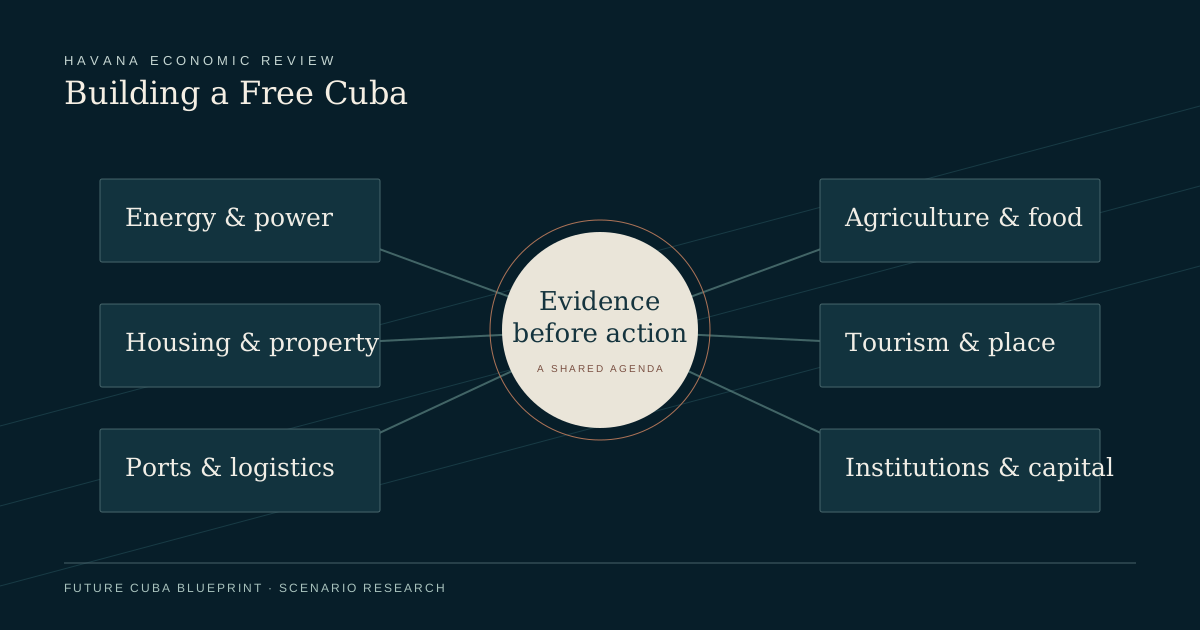
Six research desks for a possible democratic Cuba: energy, property, logistics, food, tourism and institutions, with evidence tests and a way to contribute.
AI-assisted scenario analysis · present facts are sourced · future conditions are not forecasts
Havana Economic Review Research Desk · October 1, 2026 · Miami
How can a research network assemble credible sector knowledge and willing participants before a possible democratic transition, without claiming investments are ready?
By making sector evidence traceable and giving willing participants a clear way to contribute. A useful network would show what is known, where the evidence comes from, which uncertainties matter and who has voluntarily declared an interest in investigating them.
This blueprint proposes a research architecture for Cuba Strategic Partners. The network architecture described here is proposed; sector databases and participant credentials would require their own verification. A democratic transition, its timing and its durability remain uncertain. Domains would support access to research; they would not substitute for evidence, relationships or enforceable rights.
Six desks, six tests
Each proposed desk would maintain an evidence question, a source register and a readiness test. The records below are research targets, not documents collected or authenticated for this article. Readiness means sufficient evidence for a defined next assessment, not permission to invest.
Energy: distinguish equipment from dependable service
Evidence question: What would be required to deliver dependable electricity to essential services and productive activity under a future lawful institutional framework?
Plausible primary records would include plant maintenance logs, dispatch records, feeder outage histories, fuel-delivery documentation, grid diagrams and utility accounts. Each would need dates, coverage and a clear distinction between reported capacity and demonstrated performance.
Observable readiness condition: an independently reviewable baseline connecting equipment condition, fuel availability, network constraints and maintenance requirements to a defined service area.
The desk should publish missing records alongside available ones. A generation proposal without distribution evidence would remain an unanswered engineering question.
Housing and property: separate need from rights
Evidence question: Which housing interventions could protect residents while establishing a defensible process for competing property claims?
Research targets would include cadastral maps, deeds, occupancy records, building inspections, court decisions and claims determinations. The U.S. Foreign Claims Settlement Commission documents Cuba claims programs and states that the United States has not settled those claims with Cuba. Its record is a relevant starting point, not a comprehensive Cuban property register. (justice.gov)
Observable readiness condition: a publicly specified process for identifying claims, protecting occupants, hearing disputes and recording decisions, supported by records that can be reconciled at parcel level.
The proposed desk would distinguish historical claims evidence from present occupancy and any future determination of enforceable rights. It would not label contested property “available.”
Logistics: test the whole route
Evidence question: Can a defined route move essential goods reliably, rather than merely connect attractive locations on a map?
Plausible primary records would include port maintenance surveys, berth specifications, customs procedures, cargo manifests, road and bridge inspections, warehouse inventories and rail operating logs.
Observable readiness condition: a documented route assessment tracing cargo from arrival through clearance, storage and inland delivery, with independently inspectable bottlenecks and maintenance needs.
This desk would separate physical capacity, operating performance and legal access. A port description alone would not establish a functioning supply chain. Missing customs or inland transport evidence would remain a visible constraint.
Agriculture: establish production conditions before export stories
Evidence question: What combination of land rights, water, inputs and market access could support dependable food production?
Research targets would include land-use records, soil tests, water allocations, irrigation maintenance logs, crop records, veterinary documentation and storage inspections.
Observable readiness condition: a locality-specific assessment linking lawful land access and water availability to production requirements, post-harvest handling and a credible demand study.
The desk should distinguish agronomic potential from demonstrated output. It should also make household food needs an explicit research question rather than assume that export revenue would resolve them. Neither yields nor commercial margins are verified here.
Tourism: test services and stewardship
Evidence question: Under what conditions could tourism support local livelihoods without outrunning public services or unresolved property rights?
Plausible primary records would include accommodation registers, building inspections, water and wastewater records, protected-area rules, transport schedules and official visitor statistics.
Observable readiness condition: a destination assessment reconciling service capacity, environmental safeguards, labor protections and property status before proposing expansion.
This would be a future-policy research desk, not a guide to present-regime transactions. Visitor interest would not establish local benefit. A credible assessment would show who bears infrastructure costs and how residents could contest harmful development.
Institutions and capital: identify enforceable commitments
Evidence question: Which institutions could make procurement, contracts, budgets and financial disclosures inspectable and contestable?
Research targets would include published laws, court procedures, procurement notices, budget execution reports, audited accounts and financial-supervision rules.
Observable readiness condition: procedures demonstrably used to disclose decisions, challenge awards, enforce judgments and report public spending, not simply announced reforms.
OFAC’s Cuba sanctions page identifies a framework spanning statutes, executive orders, regulations and licenses. The proposed capital desk should therefore distinguish political developments from the legal authorities governing a contemplated activity. A political transition alone would not establish authorization. (ofac.treasury.gov)
A directory of interests, not a marketplace of promises
The proposed directory would record voluntary, declared interests: sector, geography, expertise, research questions and willingness to receive an introduction. An investor could express interest in studying infrastructure governance; an operator could identify technical experience; a researcher could offer a methodology.
Each entry should distinguish self-description from independently checked credentials. Participants should control visibility, approve introductions and withdraw permission. Public profiles should omit unnecessary personal information.
An expression of interest would not be a capital commitment, operating mandate or endorsement. The directory would contain no invented funded projects and perform no automatic dealmaking. Its initial purpose would be to help people investigate shared questions.
That boundary requires care. SEC guidance says finding investors for companies or funding rounds can require broker-dealer registration; solicitation, negotiation, transaction-related compensation and handling funds are relevant factors. A directory label or consent mechanism would not itself resolve those requirements. (sec.gov)
Publish the uncertainty, then watch for evidence
The concrete public agenda should be a source register, a missing-evidence ledger, desk briefs and a consent-based directory specification. Every brief should identify its question, record provenance, conflicting evidence and the observation that would change its conclusion.
Evidence to watch would include inspectable utility performance, reconcilable property records, published dispute procedures, documented logistics reliability, local agricultural baselines and auditable institutional decisions. These are proposed tests, not findings about present readiness.
Legal changes would need their own dated record. OFAC’s program page provides regulatory and licensing references; its existence is not authorization for a proposed transaction. Any move from research toward commercial activity would require activity-specific assessment. (ofac.treasury.gov)
CSP’s proposed interest in this network should remain disclosed. This article is neither investment nor legal advice. The decisive test is whether another reader can trace a conclusion to evidence and identify the next useful piece of work.
Follow the research and contribute
Read the first-year transition planning analysis for the wider institutional context.
CSP organizes these questions in its reconstruction research desks. Investors, operators, researchers and community organizations can express research interest, describe their expertise and choose how they may be contacted. This is a route to contribute knowledge and explore useful conversations; it creates no capital commitment.
Sources & verification
- 01 U.S. Treasury/OFAC: Cuba sanctions program and licensing framework
- 02 SEC: Broker-dealers and activities relevant to finding investors
- 03 U.S. Justice Department/FCSC: Completed Cuba claims programs
Every figure sourced or labeled an estimate · Methodology
Havana Economic Review Research Desk
Institutional AI-assisted research desk. Sources and scenario assumptions are disclosed; no personal byline is implied. Methodology →