The Day-One File
The Day-One File No. 01: The Havana Ferry
For 47 years, you could drive your car onto a ship in Florida and drive it off in Havana. The route, the demand, and the licenses have all existed before. This file examines what the crossing looks like the day it becomes legal again.
Camilo Jaime · July 19, 2026 · Miami
The Day-One File is a recurring series with a simple format: one business that exists the day Cuba opens, examined with the discipline of a memo and the honesty of a label. What follows mixes verified history, cited below, with forward-looking scenario analysis that is clearly marked as such. It is not investment advice.
Here is a fact that sounds like fiction: for most of the twentieth century, you could drive your car onto a ship in Florida and drive it off the ramp in Havana. Rail ferries began working the Florida Straits in 1915, moving loaded freight cars between the two coasts. And from 1956, the City of Havana, a converted warship that had served at Normandy, made the crossing from Key West three times a week carrying 500 passengers and 125 automobiles per sailing, with air-conditioned first-class cabins, in about seven hours.
The classic American cars still rolling through Havana today did not swim there. Many of them arrived on that ferry. The service died with the embargo. Operations ceased as relations collapsed, and the ships were sold off in the early 1960s.
So the Havana ferry is not a startup idea. It is a proven product with a 47-year operating history, suspended by politics in mid-stride.
The false dawn of 2015, and its lesson
This file would be incomplete without the modern chapter. During the last thaw, the U.S. Treasury licensed at least six companies beginning in May 2015 to operate ferry service between Florida and Cuba. Operators announced routes and hoped to sail within months.
None of them ever did. The binding constraint was never Washington. It was Havana. The Cuban government never granted the dock access and operating authorizations required at its end, and the licenses expired into trivia.
That failure is the single most useful data point in this file, because it defines the trigger condition precisely: the ferry business does not begin when U.S. law permits it. It begins when a Cuban government wants it. Which means the moment to understand this business is before that government exists, while the incumbency line is still empty.
The Day-One sketch (scenario, labeled as such)
What follows is forward-looking analysis, not a report on present conditions.
The physical parameters have not changed since 1956: roughly a hundred miles of water separating the largest concentration of Cuban-Americans on earth from the island their families left. What has changed is everything else, and each change favors the route:
- The vehicle logic reverses, profitably. In 1956 the ferry carried American cars to Cuban buyers. On Day One it carries something more valuable: the diaspora’s own vehicles, tools, and goods. Families re-establishing households, contractors moving equipment, small businesses supplying relatives. A car ferry is really a cargo ferry for family-scale reconstruction, and reconstruction is measured in pickup trucks, not passenger seats.
- The demand side is pre-built. No 1950s operator had two million Cuban-Americans across the strait with existing remittance and travel relationships to the island. The route’s natural customers already exist, already travel when permitted, and already ship goods through freight forwarders at multiples of what a vehicle deck costs to operate.
- The regulatory file is pre-written. 2015 proved U.S. licensing is obtainable. The applications, the compliance frameworks, even the operator interest all exist as precedent. Day One does not start from zero; it starts from a filed template.
The honest caveats belong in the same sketch. Port infrastructure on the Cuban side would need investment before roll-on/roll-off service scales. Insurance and liability frameworks for a reopened Cuba are unwritten. A transition government’s transport priorities are unknowable today. Anyone modeling this business is modeling a range, not a number, which is exactly why the preparation phase, not the operating phase, is where the asymmetry lives.
What we are watching
- Any renewal of ferry-related license applications at Treasury. The 2015 playbook reopening would be among the earliest hard signals of a believed thaw.
- Cuban port-authority signals around Havana harbor’s continued conversion from cargo to passenger use: the infrastructure decision that determines where a ferry lands.
- The first post-transition transport ministry appointment, whenever that day comes. That is the person who decides whether 2015’s failure gets a second act.
Every Day-One File ends the same way: the opportunity is real, the timing is unknown, and the preparation is legal today. The ferry ran for 47 years. The water hasn’t moved.
Disclosure: Cuba Strategic Partners, this publication’s parent, holds Cuba-related digital assets, including in the travel and maritime sectors. See our methodology and about pages.
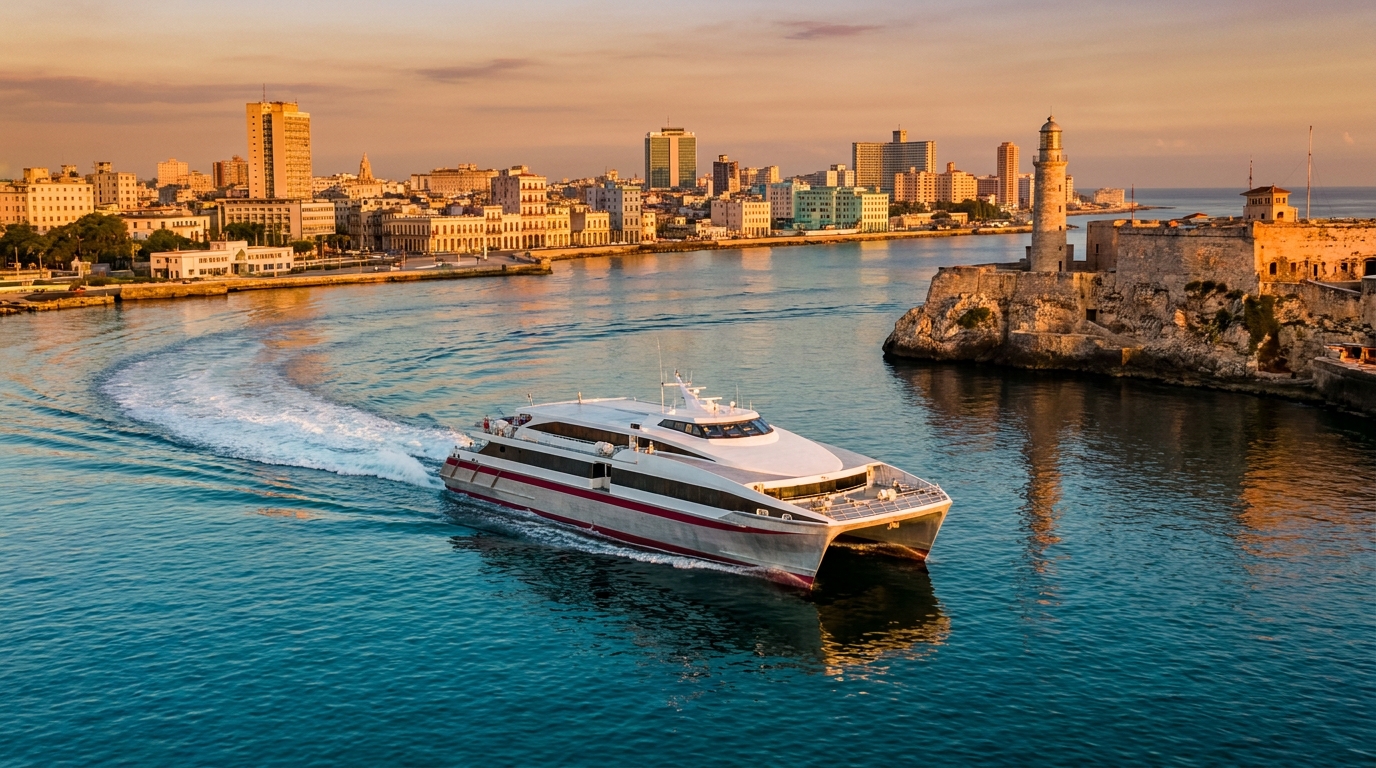
Hero image: development visualization produced for HER. It depicts a potential future, not a real vessel or current conditions.
Sources & verification
- 01 Palm Beach County History Online: 'How about a drive to Cuba, it was possible in the 1950s'
- 02 Wikipedia: West India Fruit and Steamship Company (Florida to Havana rail ferries)
- 03 CubaPLUS Magazine: Havana and Key West (the City of Havana ferry, 1956: 500 passengers, 125 cars, 7-hour crossing)
- 04 FreightWaves, Maritime History Notes: the Cuban rail ferries
- 05 Seatrade Cruise News: Florida ferry companies get licenses to serve Cuba (2015)
- 06 U.S. Treasury / OFAC FAQ 723: ferry licensing under the Cuban Assets Control Regulations
Every figure sourced or labeled an estimate · Methodology
Camilo Jaime
Founder & editor, Havana Economic Review. Miami-born, Cuban-American operator. Full bio →