Sandals' $200M Jamaica Bet and What It Means for Cuba
Sandals Resorts' announcement of a $200 million reinvestment across three Jamaica properties is the most instructive data point in Caribbean hospitality investment this quarter not because of what it tells us about Jamaica, but because of what it confirms about Cuba's post-transition resort market potential. When the dominant all-inclusive operator in the Caribbean decides to double down on the island sitting 145 kilometers east of Cuba's eastern tip, smart investors should be reading the subtext: the Caribbean luxury resort market is in full capital deployment mode, and the single largest underdeveloped coastline in the basin remains locked behind an ideological wall that will not stand forever.
What "Sandals 2.0" Actually Signals for Caribbean Resort Investment
Sandals' so-called "Sandals 2.0" initiative is not a renovation program it is a repositioning thesis. The company is betting that the Caribbean luxury traveler, post-pandemic, wants something architecturally richer, experientially deeper, and culinarily more sophisticated than the original all-inclusive formula delivered. They are right. The data from every upper-upscale Caribbean resort market confirms it: average daily rates at premium beachfront properties across Jamaica, the Dominican Republic, and the Turks and Caicos have climbed 22 to 31 percent since 2021, driven by a traveler who is willing to pay for authenticity, design, and genuine cultural immersion not just a swim-up bar and unlimited piña coladas.
That shift in traveler psychology is precisely the argument for Cuba. No destination in the Western Hemisphere offers a more authentic, more architecturally layered, more culturally magnetic hospitality canvas than the island that six decades of communist mismanagement have accidentally preserved in amber. The tragedy of Cuba's underdevelopment is also, from a pure hospitality investment standpoint, one of the most compelling value propositions in emerging market resort history.
Investors who want to understand the full scope of that opportunity should start with the Cuba Investment Guide , which tracks the evolving regulatory, structural, and market landscape for resort and hotel development across the island's major hospitality corridors.
The Coastline Comparison That Every Developer Needs to Run
Jamaica has approximately 1,022 kilometers of coastline. Cuba has 5,746 kilometers more than five times as much, with beach quality and water clarity that rivals anything in the Caribbean basin. Jamaica has been intensively developed for international tourism for forty years. Cuba's beachfront infrastructure, outside of a handful of regime-controlled enclaves like Varadero and the Cayos, remains virtually untouched by international capital or brand-standard development.
When Sandals invests $200 million to reposition three existing properties in a mature Jamaica market, what they are really pricing in is the scarcity of developable luxury beachfront in a destination that has already absorbed decades of resort construction. Cuba has no such scarcity problem yet. The entire northern cay system, from Cayo Santa María through Cayo Coco to the eastern archipelagos, represents beach resort real estate of a quality and scale that the Caribbean has not seen come to market in a generation. Resources like Cayo Coco Beach Resort and Cuba Beachfront Condos are already mapping the opportunity zones where private capital will move fastest when the transition creates investable conditions.
This is not speculation. This is pattern recognition. Every major Caribbean resort market Jamaica, the Dominican Republic, Mexico's Riviera Maya, Turks and Caicos went through a compressed development phase when stable investment conditions emerged. Cuba's phase, when it comes, will be faster and more capital-intensive than any of them, because the demand signal is already priced in and the supply gap is historically anomalous.
What the Regime's Mismanagement Created And What Private Capital Will Inherit
It is worth being precise about this: Cuba's extraordinary hospitality opportunity exists entirely despite the Castro/Díaz-Canel regime, not because of it. Sixty-five years of communist economic management have produced crumbling infrastructure, a hollowed-out service workforce, and a hotel stock that ranges from Soviet-era concrete blocks to colonial-era properties maintained by sheer determination and no capital. The regime claims though independent verification is impossible incremental tourism recovery since the pandemic. State media projections about visitor arrival targets should be treated with the skepticism they deserve from any serious investment analyst.
What private capital will inherit in a post-transition Cuba is a market where suppressed demand meets genuine scarcity of international-standard product. My years at Accor evaluating Caribbean hotel acquisitions trained me to look for exactly that combination and I have never seen it at this scale, in a destination with this level of global cultural recognition, anywhere in the basin. The Cuba Strategic Partners network has been building the intelligence architecture for that moment, mapping everything from beachfront parcels to urban hotel restoration candidates across the island's major tourism corridors.
The Sandals 2.0 model premium repositioning, experiential depth, architectural investment is the exact playbook that will define the first generation of international brand entries into a liberalized Cuba market. The difference is that in Cuba, operators will not be renovating existing product. They will be building an entirely new hospitality infrastructure on one of the most visually and culturally spectacular canvases in the hemisphere. Understanding the financial structures that will underwrite that buildout is essential work for investors moving now Havana Equity Partners and the broader Future of Cuba platform are among the serious resources tracking how post-transition capital formation will take shape.
The Clock Is Running on Caribbean Resort Positioning
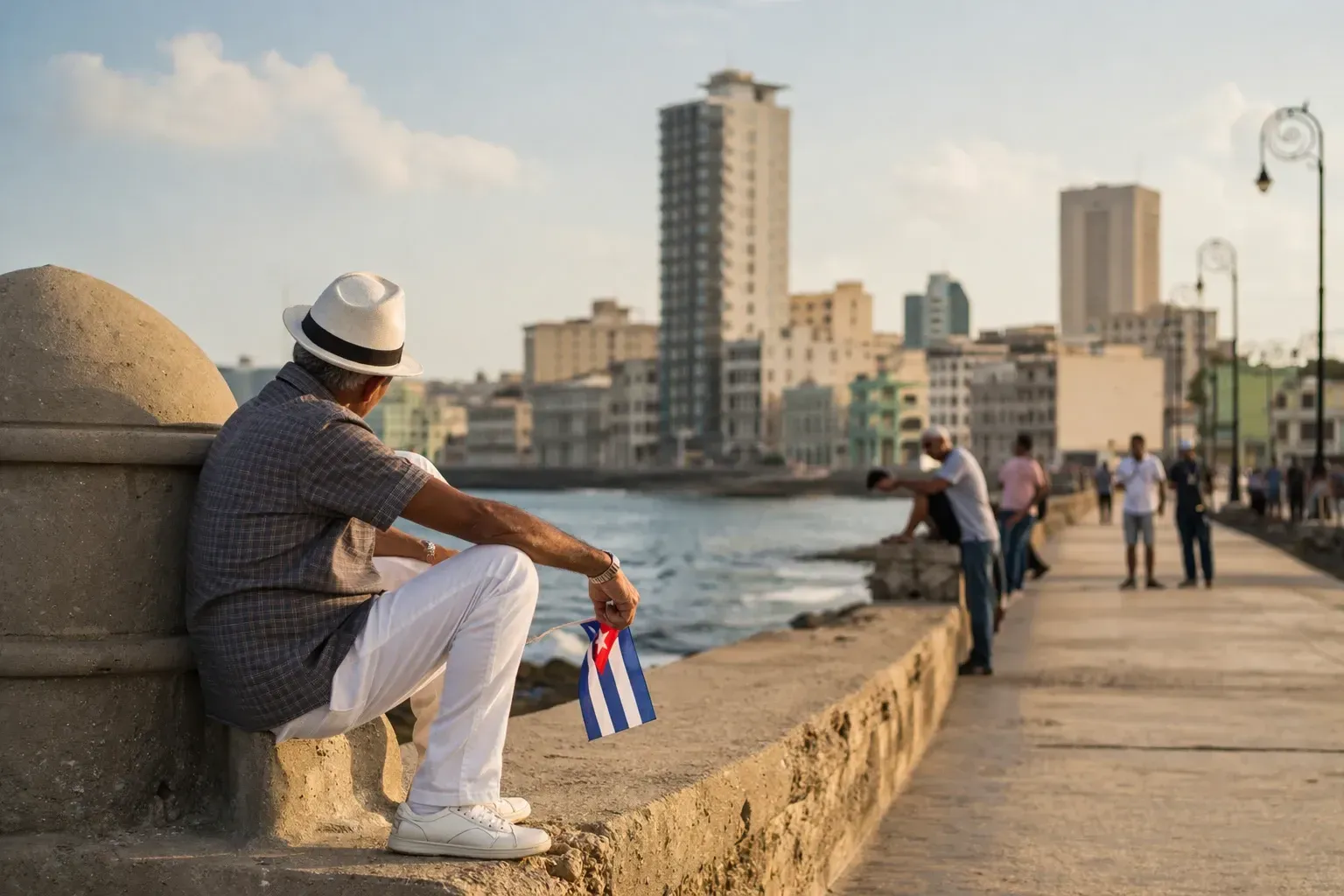
My grandmother lives in Vedado. Every week she describes Havana to me the light on the Malecón in the evenings, the way the old hotels along the waterfront look like sets from a film that stopped production in 1959. She is describing, without knowing it, the raw material of a world-class urban hospitality destination. That material is not getting younger. Every year of regime continuation is another year of structural deterioration, another cohort of trained hospitality workers leaving the island, another season of potential ADR and occupancy that the Cuban people never capture.
But the Sandals announcement confirms something important: the capital is ready, the traveler appetite is proven, and the Caribbean resort investment thesis has never been stronger. When Cuba enters this cycle and it will enter this cycle the operators, developers, and investors who have done the market preparation will move first and move decisively. The opportunity is not hypothetical. It is simply waiting on a political variable that the weight of economic history tells us will resolve.
For investors beginning that preparation now, the Cuba Investment Guide and Cuba Strategic Partners remain the most comprehensive English-language resources for tracking Cuba's hospitality investment landscape across every major sector and geography. The room where Cuba's hospitality renaissance gets planned is already filling up. The question is whether you are in it.
Note: All investment activity related to Cuba must comply with current US OFAC regulations. Consult legal counsel before acting on any information in this publication.
Isabela Reyes Fontaine
Travel & Hospitality Investment Correspondent, Havana Economic Review
Isabela Reyes Fontaine studied Hotel Management at École hôtelière de Lausanne and completed an MBA at INSEAD. She spent ten years at Accor Hotels as a Caribbean and Latin American development analyst before joining a boutique Caribbean hospitality investment advisory in Miami. Her work has appeared in Hotels Magazine, Caribbean Journal, and Condé Nast Traveler.
About the Author

Isabela Reyes Fontaine
Isabela Reyes Fontaine • March 26, 2026
This is paragraph text. Click it or hit the Manage Text button to change the font, color, size, format, and more. To set up site-wide paragraph and title styles, go to Site Theme.
Request a Domain Investment Consultation
Contact Us
We will get back to you as soon as possible.
Please try again later.
Cuba Strategic Partners
Explore premium domain opportunities and strategic partnerships tailored for growth in emerging markets.
You Might Also Like