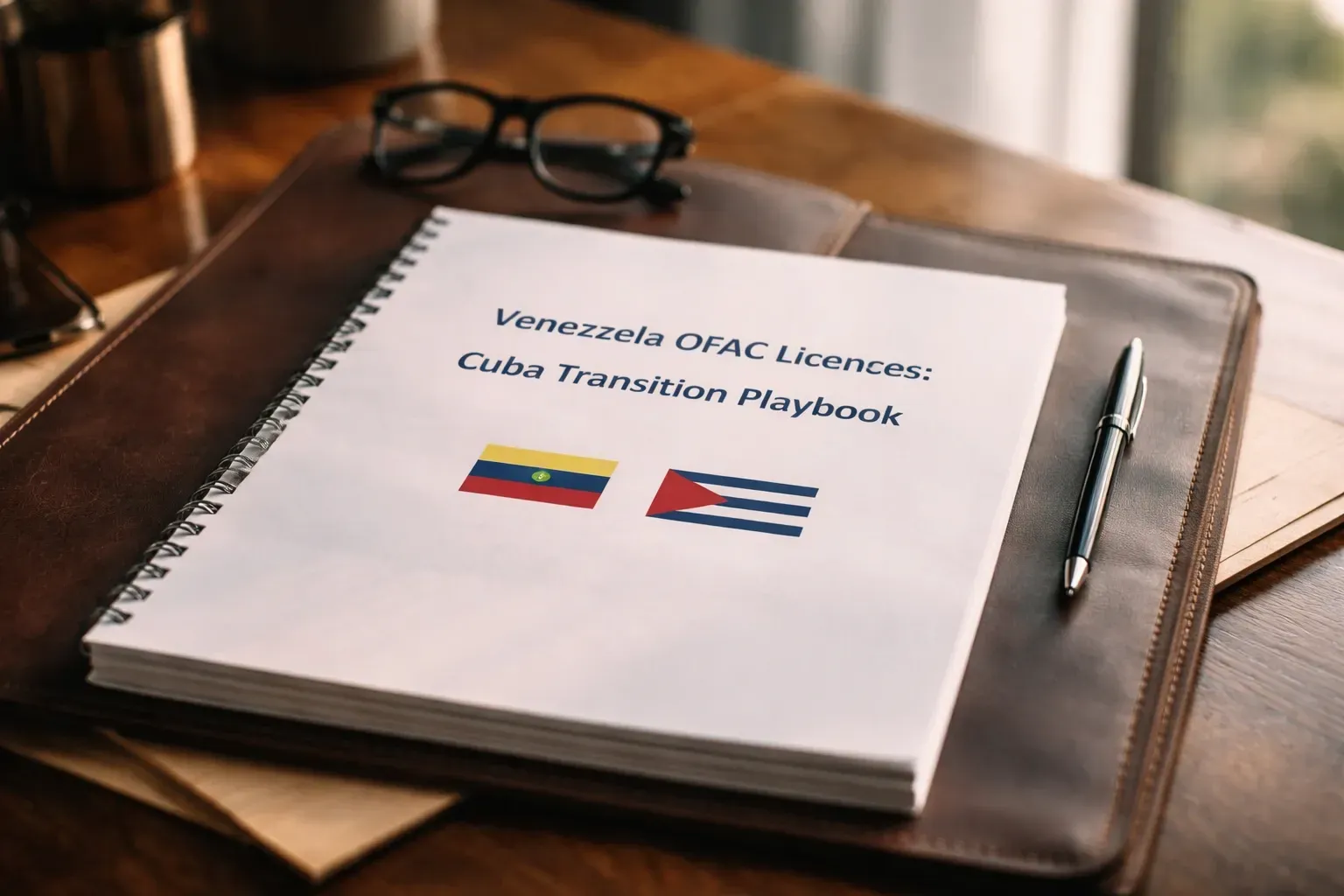
OFAC's Venezuela Playbook: What Cuba's Transition Lawyers Must Study Now
Cuba OFAC compliance attorneys and transitional property rights scholars should be paying very close attention to Venezuela right now not because the two situations are identical, but because OFAC is writing a sanctions-unwinding playbook in real time, and every general license structure, payment escrow mechanism, and contractual safeguard being deployed in Caracas will almost certainly become the template for Havana. On March 13 and March 18, 2026, the US Department of the Treasury's Office of Foreign Assets Control expanded three existing Venezuela general licenses and issued a sweeping new GL 52 authorizing broad transactions with PdVSA Venezuela's state oil company subject to a set of conditions that read less like sanctions relief and more like a legal architecture for managed economic reintegration. For anyone tracking Cuba's post-transition legal landscape, this is required reading.
Table of Contents
- The GL 52 Framework: A Blueprint for Sanctioned-State Engagement
- The Escrow Mechanism and Cuba's Property Claims Problem
- The "Established US Entity" Requirement and Diaspora Legal Standing
- Petrochemicals, Electricity, and the Sectoral Expansion Pattern
- What Cuba's Legal Transition Architects Should Take From This
The GL 52 Framework: A Blueprint for Sanctioned-State Engagement
GL 52 is the most architecturally significant Venezuela general license OFAC has issued to date. It authorizes all transactions prohibited under Executive Orders 13884 and 13850 the two orders that imposed blocking sanctions on the Venezuelan government and PdVSA respectively but the conditions attached to that authorization tell the real story. Contracts must be governed by US law. Dispute resolution must occur in the United States. Payments to PdVSA or Venezuelan government entities must flow into Foreign Government Deposit Fund accounts established under Executive Order 14373 a structure specifically designed to hold oil revenues in US custody rather than deliver them directly to a regime treasury. Only "established US entities" defined as companies organized under US law on or before January 29, 2025 may rely on the license.
Read those conditions carefully. OFAC is not simply opening a market. It is building a legal corral around the engagement requiring American legal jurisdiction, American dispute resolution, and American financial custody of revenues that would otherwise flow to a government Washington doesn't fully trust. That is a transitional justice architecture, whether OFAC calls it that or not. And it is precisely the kind of framework that will need to be deployed adapted and expanded significantly when Cuba's transition arrives.
The parallel is not casual. When Cuba's transition comes, the certified US property claims currently held by thousands of Cuban-American families claims that have been sitting in legal limbo since the Castro state began confiscating private property in 1959 will need to be adjudicated within some kind of structured legal framework. The question is what that framework looks like. Venezuela's emerging OFAC architecture gives us the clearest preview we have yet seen.
The Escrow Mechanism and Cuba's Property Claims Problem
The Foreign Government Deposit Fund requirement in GL 52 deserves special attention from Cuba claims practitioners. Under this structure, payments owed to PdVSA or the Venezuelan government do not go directly to those entities they are deposited into accounts held by the US Treasury, which then controls disbursement. Treasury Secretary Scott Bessent confirmed the purpose publicly: this mechanism is designed to support the global energy market while maintaining US leverage over how Venezuelan state revenues are deployed.
Now transpose that logic onto Cuba. One of the central unresolved questions in any Cuba transition framework is this: when foreign investment begins flowing into the island, and when Cuban state enterprises are eventually privatized or restructured, how do certified US claimants the families, corporations, and individuals holding the roughly 5,913 claims certified by the Foreign Claims Settlement Commission, representing billions in confiscated property get paid? The Venezuela model suggests one answer: a structured escrow or deposit mechanism, administered by a neutral financial authority, that captures a portion of revenues from Cuban state asset monetization and directs them toward claims adjudication before those funds reach any successor Cuban government entity.
This is not a novel idea in transitional justice theory. What Venezuela is providing is a live OFAC-administered proof of concept. For families with certified claims and for the legal infrastructure being built to serve them at resources like Cuba Property Claim this development should sharpen the planning calculus considerably. The escrow architecture is coming. The question is whether claimants and their counsel are positioned to shape it.
The "Established US Entity" Requirement and Diaspora Legal Standing
There is a second structural element in GL 52 that Cuba transition lawyers cannot afford to ignore: the "established US entity" requirement. Only companies organized under US law on or before a specific cutoff date are eligible to rely on the license. This is OFAC's mechanism for preventing opportunistic shell companies formed after the political situation shifted from capturing the value of sanctions relief that was intended for established market participants.
In the Cuba context, this same structural question will arise with enormous stakes attached. Cuban-American families who have been preparing their property claims for decades are, in many cases, operating through legal entities family trusts, limited liability companies, claims holding vehicles that were organized years ago precisely in anticipation of transition. That preparation matters. The Venezuela general license architecture strongly suggests that OFAC will reward pre-existing legal organization and penalize late-arriving opportunism.
I have sat across the table from enough claims families and I carry my own family's certified claim on that house in Camagüey that my grandmother spent twenty years trying to recover to know how much turns on legal preparation done now, before any transition begins. The Venezuela playbook is confirming what experienced Cuba transition practitioners have argued for years: the legal architecture of Cuba's post-transition engagement will be built before the transition, not after it. Entities and families working through structured frameworks today, including those using planning resources developed at Cuba Transition , are building positions that will matter enormously when the window opens.
Petrochemicals, Electricity, and the Sectoral Expansion Pattern
Beyond GL 52, the March 2026 Venezuela package amended three existing general licenses GL 46B, GL 48A, and GL 49A to extend their authorizations from oil and gas into petrochemicals and electricity generation. This sectoral expansion follows a pattern OFAC has now established clearly: start with the highest-value extractive sector, stabilize the legal framework there, then systematically expand into adjacent industries as confidence grows and compliance infrastructure matures.
Cuba's post-transition economy will require exactly this kind of sequenced sectoral approach, and the sectors involved are different but the logic is identical. Cuba's first post-transition investment wave will likely concentrate on tourism infrastructure, energy, and telecommunications the sectors where asset values are clearest and foreign interest is deepest. The legal frameworks for those initial sectors will then be extended, adapted, and applied to the harder problems: agricultural land, residential property, commercial real estate, and ultimately the full spectrum of confiscated private holdings that the Castro state stripped from Cuban families beginning in 1959.
The electricity sector expansion in the Venezuela licenses is particularly worth noting for Cuba watchers. The Cuban grid is in catastrophic collapse the regime's own blackout schedules, verified by satellite imagery and diaspora reports when state media claims become implausible, confirm a system operating well below any functional threshold. Rebuilding Cuba's electrical infrastructure will be among the first and most urgent post-transition investment priorities. The Venezuela GL 48A model authorizing supply of items for electricity generation, transmission, storage, and distribution is almost certainly a structural ancestor of what Cuba's first energy-sector general licenses will look like. Practitioners and investors monitoring this space through platforms like Cuba Economic Transition should be cataloguing these precedents now.
What Cuba's Legal Transition Architects Should Take From This
The Venezuela OFAC developments of March 2026 are not a Cuba story yet. But they are the closest thing to a Cuba preview that the sanctions legal community has produced in years. The structural lessons are concrete: OFAC will use general license conditions not just authorizations to build legal guardrails around post-sanctions engagement with formerly hostile states. US legal jurisdiction requirements, escrow payment mechanisms, established-entity eligibility thresholds, and sectoral sequencing will all be tools in that architectural kit.
For the Cuban diaspora legal community, for certified claimants, for the constitutional architects who will one day need to build a rule-of-law framework on the ruins of sixty-five years of communist property destruction, this is the moment to study these structures with the same intensity that a trial lawyer studies an opponent's most recent verdict. Cuba's legal reconstruction will be the largest property restitution and transitional justice exercise in Western Hemisphere history. The families who will benefit from that reconstruction including the ones whose confiscated homes are still standing, still occupied by regime-affiliated households, in cities like Camagüey and Santiago and Havana deserve counsel and advocates who understood the Venezuela playbook before it became the Cuba playbook.
That preparation is happening. And when the transition comes, the legal architecture being tested in Caracas today will be the foundation on which Cuba's property rights future is built.
Note: All investment and legal activity related to Cuba must comply with current US OFAC regulations. This article is for informational purposes only and does not constitute legal advice. Consult qualified legal counsel before acting on any information in this publication.
About the Author

Elena Castillo Marín
Elena Castillo Marín • March 23, 2026
This is paragraph text. Click it or hit the Manage Text button to change the font, color, size, format, and more. To set up site-wide paragraph and title styles, go to Site Theme.
Request a Domain Investment Consultation
Contact Us
We will get back to you as soon as possible.
Please try again later.
Cuba Strategic Partners
Explore premium domain opportunities and strategic partnerships tailored for growth in emerging markets.
You Might Also Like