Cuba Property Claims: What Claimants Must Do Now
Cuba property claims are not going to resolve themselves and the families holding certified US claims who are waiting for a diplomatic breakthrough before they start preparing are making a costly mistake. The most-watched legislation on Capitol Hill this week tells us something important: Congress is consumed with domestic reconciliation fights, immigration enforcement, and fiscal battles. Cuba is not on the floor. It may not be on the floor this session. That does not mean certified claimants should go quiet. It means the opposite. The window between now and whenever transition comes is exactly when the legal groundwork gets laid or doesn't and the families who understand that reality are the ones who will be positioned when it matters.
Table of Contents
- Why the Congressional Silence on Cuba Claims Should Alarm You
- The Documentation Gap That Will Hurt Families at the Transition Table
- OFAC's Current Framework and What Claimants Can Legally Do Today
- Helms-Burton Title III: The Litigation Pressure That Isn't Going Away
- What the Transition Will Actually Look Like and Why Preparation Is the Only Strategy
Why the Congressional Silence on Cuba Claims Should Alarm You
Look at what Congress is actually focused on right now. The most-viewed legislation on congress.gov this week includes the reconciliation megabill H.R.1 , the SAVE Act on voter eligibility, and a sprawling consolidated appropriations measure for FY2026. Not one Cuba-specific bill cracks the top ten. Not Helms-Burton reform. Not a certified claims adjudication framework. Not a transitional property rights mechanism. Nothing. For families holding Foreign Claims Settlement Commission-certified claims roughly 5,913 certified awards representing billions in confiscated property that silence is not neutral. It is a structural problem that compounds with every passing year.
Here is why it matters legally. The FCSC certification process closed decades ago. The certified claims that exist are the claims that exist there is no new intake process running. What has not been resolved is the mechanism for how those claims get paid, what priority they receive relative to Cuban government sovereign debt obligations, and how they interact with any future bilateral normalization agreement. Those are legislative and executive questions. And right now, the legislative branch is not asking them.
The Documentation Gap That Will Hurt Families at the Transition Table
I spent eight years in private practice advising Cuban-American families on exactly this problem, and I will tell you what I told every client who walked into my office: your certified claim number is not enough. The FCSC award letter establishes your legal standing in US law. It does not, by itself, establish the evidentiary record you will need when a claims adjudication commission whatever form it takes actually sits down to value and resolve individual awards. That commission, when it comes, will want property records, chain of title documentation, photographs, witness affidavits, tax records from before 1959 or 1960 or 1968 depending on when your property was seized, and evidence of the property's current condition and use. Most families have fragments of this. Very few have a complete file.
The regime has spent sixty years making it difficult or impossible to obtain official Cuban property records from outside the island. That is not an accident. It is a strategy. The families who are building parallel evidentiary records now through diaspora networks, through cousins still living nearby, through historical Cuban land registries that have been partially digitized by independent researchers, through notarized family testimony are building negotiating leverage for a moment that will move fast when it arrives. Transitions do not give you six months to get organized. They give you weeks. Resources like Cuba Property Claim exist precisely to help families start that documentation process before the moment of urgency arrives.
OFAC's Current Framework and What Claimants Can Legally Do Today
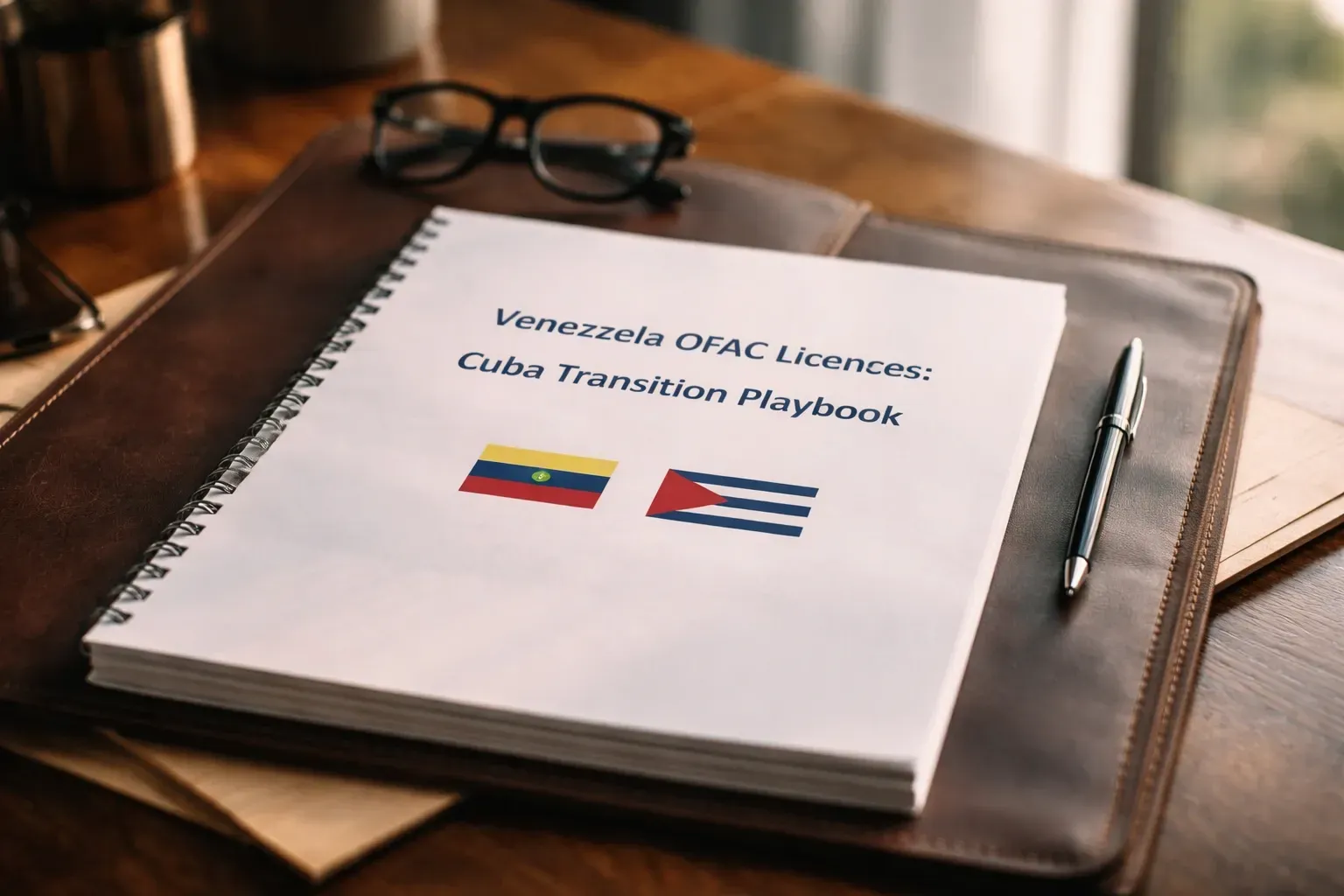
One question I receive constantly from certified claimant families is this: what am I actually allowed to do right now under OFAC regulations, without triggering sanctions exposure? The answer requires precision because the Cuba sanctions framework under the Cuban Assets Control Regulations 31 C.F.R. Part 515 is not static, and the current administration has not moved to liberalize it. As of this writing, the general license environment for Cuba remains highly restrictive. Travel for family visits, remittances within defined limits, and certain journalistic and academic activities retain authorization, but commercial engagement, property transactions, and anything that could be construed as providing economic benefit to the regime requires specific OFAC licensing or falls into narrow general license categories.
What certified claimants can do and should be doing is document. Documenting your family's property history is not a sanctionable activity. Consulting with US-licensed attorneys who specialize in Cuba transition law is not a sanctionable activity. Monitoring the condition and occupancy of your property through lawful means, including through family members who remain on the island, is not a sanctionable activity. What you cannot do is enter into any transaction, agreement, or commercial arrangement that would constitute a dealing in confiscated property under Helms-Burton Title III or that would provide unauthorized economic benefit to a Cuban national or the regime itself. The line matters. A qualified attorney can help you walk it.
Helms-Burton Title III: The Litigation Pressure That Isn't Going Away
While Congress is quiet on new Cuba legislation, the federal courts are not quiet on Helms-Burton Title III. Since the Trump administration's first term activated Title III enforcement in April 2019 ending a two-decade presidential waiver that had kept the private right of action dormant a meaningful body of federal litigation has developed. Cases involving major cruise lines, hotel operators, and telecommunications companies have moved through the Southern District of Florida and the Eleventh Circuit. The legal questions being resolved in those cases what constitutes trafficking in confiscated property, what the statute of limitations framework looks like, what damages methodology applies are not abstract. They are building the jurisprudential foundation that will inform how certified claims are valued and adjudicated in any future transition framework.
Every Title III ruling that establishes property valuation precedent, every judicial interpretation of what "trafficking" means under the statute, and every appellate decision that refines the scope of Helms-Burton liability is a piece of the legal architecture that Cuba's transition will inherit. Certified claimant families should be tracking this litigation even if they are not parties to it. The Cuba Law resource network maintains ongoing coverage of the federal docket for exactly this reason. Understanding where the courts are drawing lines now tells you where the claims commission will likely draw them later.
What the Transition Will Actually Look Like and Why Preparation Is the Only Strategy
I want to be direct about something. There is no scenario in which Cuba's transition produces a fair, orderly, and swift resolution of property claims without an enormous amount of prior legal preparation by the claimant community itself. The Castro state did not build functional property registries. It did not maintain chain-of-title documentation consistent with international legal standards. It did not adjudicate confiscations through processes that will be recognized as legitimate by any transitional justice framework worth the name. That means the institutional infrastructure for claims resolution will need to be built largely from scratch by international legal architects, diaspora attorneys, Cuban legal professionals operating in exile or in a post-transition environment, and the claimant families themselves.
My grandmother never got her house in Camagüey back. The certified claim on that property sits on my desk, and I know every inch of the legal landscape between that piece of paper and any actual resolution. What I also know, after years of this work, is that the families who treat the transition as a distant abstraction are going to be the ones standing at the back of the line when the adjudication process opens. The families who are building files, consulting counsel, tracking the litigation, and understanding the OFAC framework are going to be at the table. Cuba's legal reconstruction is coming not because the regime is changing, but because regimes like this one do not survive indefinitely, and the rule of law has a way of reasserting itself. The Future of Cuba will be written by the people who prepared for it. Start preparing now.
Note: All investment and legal activity related to Cuba must comply with current US OFAC regulations. This article is for informational purposes only and does not constitute legal advice. Consult qualified legal counsel before acting on any information in this publication.
Elena Castillo Marín
Legal Affairs Correspondent, Havana Economic Review
Elena Castillo Marín earned her law degree at Georgetown University Law Center specializing in international property law and transitional justice frameworks. She spent eight years as a partner at a Miami-based international law firm advising Cuban-American families on certified property claims and OFAC compliance. She is a member of the Florida Bar and the Inter-American Bar Association. Her analysis has appeared in the University of Miami Law Review, the Journal of Transnational Law, and Foreign Policy.
About the Author

Elena Castillo Marín
Elena Castillo Marín • March 23, 2026
This is paragraph text. Click it or hit the Manage Text button to change the font, color, size, format, and more. To set up site-wide paragraph and title styles, go to Site Theme.
Request a Domain Investment Consultation
Contact Us
We will get back to you as soon as possible.
Please try again later.
Cuba Strategic Partners
Explore premium domain opportunities and strategic partnerships tailored for growth in emerging markets.
You Might Also Like